

What Is The Religious Make Up Of Africa What Is The Religious Makeup Of Africa
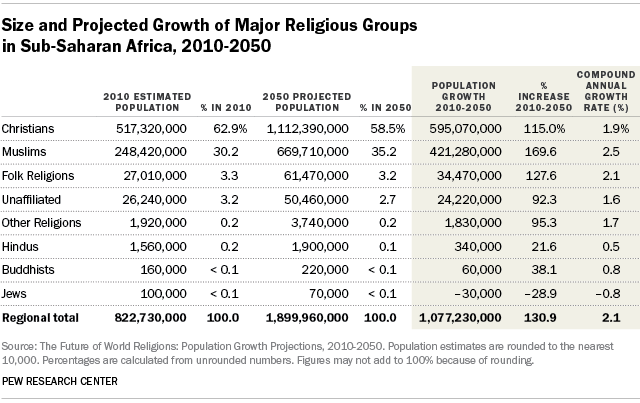
The full population in sub-Saharan Africa is expected to grow at a faster stride than in whatsoever other region in the decades ahead, more than than doubling from 823 million in 2010 to 1.9 billion in 2050. As a result, the two dominant religions in the region – Christianity and Islam – both are expected to have more than than twice as many adherents in 2050 as in 2010.71
Christians are projected to remain the region's largest religious group, growing from 517 meg in 2010 to more than ane.i billion in 2050. Just the Muslim population is expected to grow at a faster rate than the Christian population (170% vs. 115%), rising from 248 million to 670 million. Near of the smaller religious groups in sub-Saharan Africa, including adherents of folk religions and the religiously unaffiliated, are expected to experience at least pocket-sized growth in the decades alee, although the minor Jewish population is projected to shrink.
While the accented number of Christians in sub-Saharan Africa is expected to double in size by 2050, the Christian share of the region'due south population is expected to decline, dropping from 63% in 2010 to 59% in 2050. Meanwhile, the Muslim share is projected to increase from 30% to 35%.
Factors Driving Change
Fertility
 The Total Fertility Rates for the two fastest-growing religious groups in sub-Saharan Africa – Muslims and adherents of folk religions – are college than the rates for Christians and the unaffiliated. Withal, fertility rates for all major religious groups in sub-Saharan Africa are considerably college than the replacement level of 2.one children per adult female.
Historic period Structure
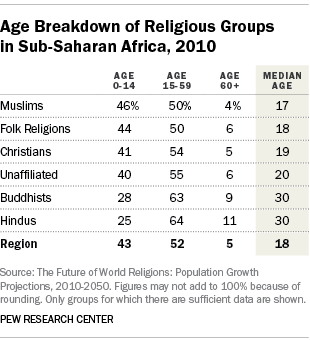 The groups projected to experience rapid growth in sub-Saharan Africa in the decades ahead had very young populations in 2010. Nigh one-half of the region's Muslims (46%) were under age 15, as were 44% of those adhering to folk religions, 41% of Christians and 40% of the unaffiliated.
The median ages of these groups ranged from 17 (for Muslims) to 20 (for the unaffiliated). The median historic period for the region overall was 18.
Religious Switching
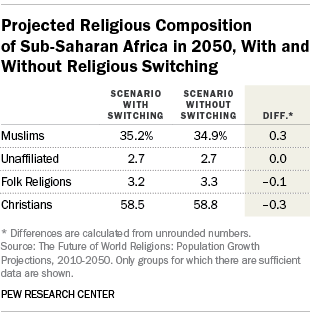 Religious switching is expected to change the religious landscape of sub-Saharan Africa in future decades only modestly. (For information on the impact of religious switching on the demographic projections in this written report, see Affiliate 1.) The Muslim share of sub-Saharan Africa'due south 2050 population is expected to be 0.3 percentage points higher than information technology would be if projected religious switching were not taken into business relationship. By contrast, the projection for the Christian share of the region in 2050 is 0.3 percentage points lower than if religious switching were not included in the projections.
Migration
In the decades ahead, more migrants are expected to move out of sub-Saharan Africa than move into the region. This outbound migration is not expected to accept a big impact on the overall religious composition of the region. Consequently, the report does non testify different projection scenarios with and without migration for this region.
Source: https://www.pewresearch.org/religion/2015/04/02/sub-saharan-africa/
Posted by: markhamkinatim.blogspot.com
0 Response to "What Is The Religious Make Up Of Africa What Is The Religious Makeup Of Africa"
Post a Comment